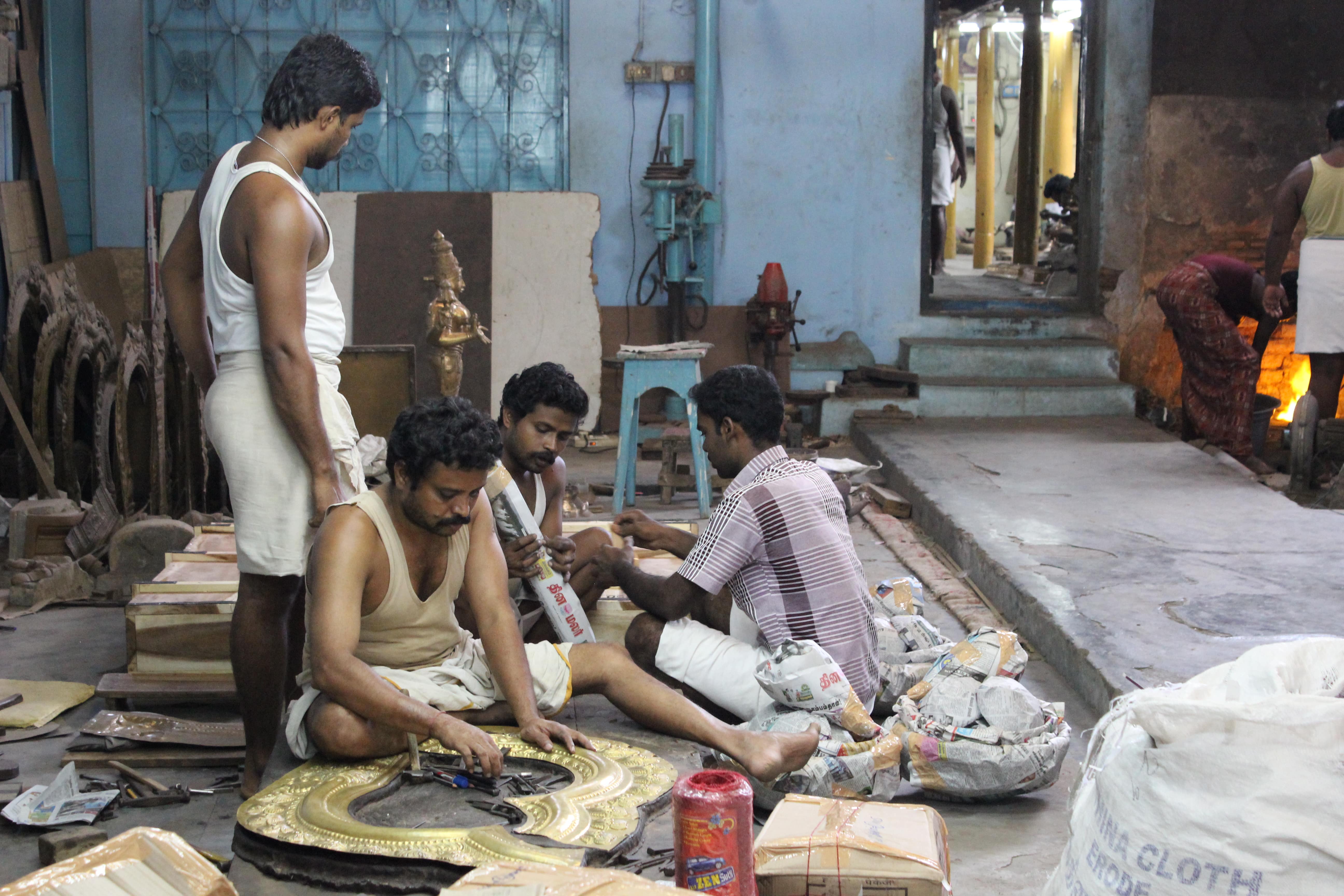
The Swamimalai sculptor community in Tamilnadu, India claim a artistic heritage dating to the 9th century CE, tied to the Imperial Chola’s temple building projects. The hereditary bronze casters, or Sthapathis, of Swamimalai have historically been from one community, the Vishvakarma Sthapathy caste, but not anymore. The post-independence (1947) Indian Government saw a need to remove caste categories as occupationally exclusive delineations and created schools to teach the 'lost wax' method of icon production to anyone interested in learning.
With data collected over an 8-year period, consisting of multimedia, 3D models, and GIS, the website is an archive to be used to craft narratives. The site has been created using website development technologies, including HTML, JavaScript, CSS, PHP, and MySQL. These technologies allow the site to be interactive and allow users to create their own narratives in an engaging user experience. Visitors to this site, envisioned as students, choose an anthropological category ("Tradition", "Governmentality”) and put together materials from the archive to create and publish their anthropological narrative about the Swamimalai sculptors. The published narrative will be open for review and comments from the public, thus encouraging the writers to be reflexive about their position as unilateral narrators of the stories of "others", thus encouraging empathy and critical thinking.
Furthermore, by opening up the practice of anthropological writing to the public, this project aims to reintroduce experimentation into anthropological writing. Under CCAS’s ‘At-Risk World Heritage and the Digital Humanities’, this sub-project contributes to the UC Office of the President Catalyst grant by helping to develop an online curation program for both tangible and intangible cultural heritage, contributing an ethnoarchaeological analogy to understand the organization of metallurgical technology in the Levant and Mediterranean.