

The art of traditional icon production was guarded by the Vishwakarma Sthapathis until shortly after India’s independence when so many traditional aspects of caste and class underwent change.35 In December, 1958, the Swamimalai Icon Manufacturers Co-operative Cottage Industrial Society Limited was established as the 285th co-operative in the country as a credit and marketing society.36 These products continue to be sold to- day throughout the country through the All India Handicrafts Board. The establishment of the co-operative provided an organization to not only help market icons, but also insure standards for artistic quality by having a Sthapathi master craftsman on the board. In the 1950s, the Department of Industries and Commerce at Swamimalai established a training institute, called Poompuhar, to train both Sthapathi and non-Sthapathi boys in the traditions of icon production described in the Shilpashastra. To maintain adherence to metal icon traditions, the supervision of the Poompuhar has been under a Sthapathi master craftsman. Thus, following India’s independence, to help develop the village economy of Swamimalai, the traditional social organization of icon craft specialization changed radically by taking icon production out of the strict control of the hereditary bronze casters, and giving individuals from other castes and religions the opportunity to make a living as bronze icon manufac- turers – mostly with the aim of reaching the handicrafts market. Consequently, the hereditary bronze casters were supportive of the establishment of the Co-operative Society from its beginning.

Data from 1961 indicate that there were a total of 26 ‘skilled Sthapathis’ from 17 families actively engaged in icon production in Swamimalai of which Nambiar classified 17 individuals as “very skilled craftsmen.” As an outside observer, Nambiar did not indicate how this ranking of Sthapathi skill level was made. Today, and presumably in the past, Sthapathis are reluctant to rank the skill levels of their cohort because they are all related family members (Fig. 7), and hence, they are sensitive to the feelings of all members of the clan. In addition, Sthapathis are generally self-effacing when it comes to their prowess as craftsmen. For the purposes of this study, the more general category of ‘skilled Sthapathi’ craftsman is used to make it possible to compare the 1961 census data with today. The ranking used here was achieved by asking four Swamimalai Sthapathis from 2 different families not closely related on the genealogical tree to make the ranking. They were able to determine which sons stayed in the family craft tradition and those that left icon production for other work. Accordingly, in February, 2007, there are now 52 skilled hereditary Sthapathi practicing in Swamimalai today or a ca. 50% increase in active Sthapathi craftsmen over the past 46 years. While data collected in 2005 from the Swamimalai Co-operative Society show that there were a total of 156 registered members, which includes both Sthapathi and non- Sthapathi individuals who practice icon production, this does not include all skilled craftsmen. The total number of individuals who are involved in the production of icons (from simple ‘jobbers’ to ‘master craftsmen’) in the village may be as large as 300. Based on these data, traditional icon production amongst the hereditary bronze casters can be characterized as extremely healthy and growing through time. Some of the reasons for this will be discussed at the end of this study.
As this study is a collaboration between ‘outsider’ researchers and the ‘insider’ Sthapathi informants, the taxonomy and typologies used here, whether discussion is focused on the organi- zation of production or the tools used by the metal workers, combines a blend of emic and etic approaches to anthropological observation (38). David and Kramer (39) assert that archaeologists are experts in the development of typologies for analytical purposes. For ethnoarchaeologists, Brian Hayden (40) says, “Typologies can be devised to resolve problems of temporal relationships, cultural affiliation, and tool use; to identify individual manufacturing styles...; to identify community styles, trade, and technological processes; to estimate interaction between communities...’ to monitor recycling and status differences; to help interpret religious structures and beliefs; to distinguish between egalitarian... and hierarchical...social organizations; or to deal with any other specific interpretational problems of interest.” The Tamil name used by the Sthapathis for ‘workshop’ is Pattarai and for reasons of modesty alluded to above, the term Patterai is used by the Sthapathis, the Co-op, and the Poompuhar to refer to all workshops regardless of size, complexity or economic success. Thus, the dynamics of changes in icon production today are not accounted for by the ‘folk classification’ used by the practitioners themselves. As Hayden and Cannon (41) point out, the problem with many folk classifications is “that people are generally unaware of and unable to explain the principles upon which the folk classification they use are founded...” Thus, the typology of production used here is an etic one that is based on the 2004 – 2007 ethnoarchaeology field observations that show six generic types of icon production (from complex to simple):
- Hereditary Family Owned Manufactory
- Hereditary Family Workshop
- Individual Hereditary Skilled Craftsmen
- EntrepreneurOwnedManufactory
- Family/Entrepreneur Workshop
- Individual Skilled Craftsmen
Each of these production types is discussed in detail below. In terms of the spatial organization of the Pattarai, both hereditary and non-hereditary manufactories and workshops have similar elongated architectural spatial ‘foot prints’ whether they are in the house or separate building (Fig. 16). This elongated spatial layout of the workshops reflect the chaîne opératoire, that is the “series of operations which transforms a substance from a raw material into a manufactured product” (42), of traditional metal icon production in Swamimalai. A detailed discussion and plan of the spatial layout of a Hereditary Family Owned Manufactory is presented below in Chapter 5. What follows are brief definitions of the different types of icon production in Swamimalai:
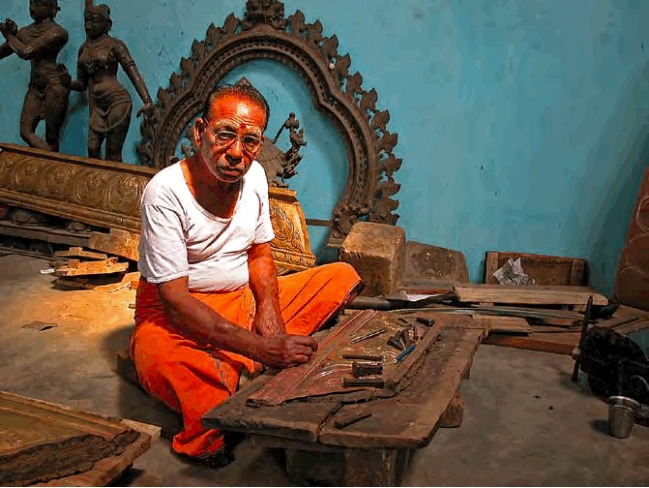 Hereditary Family Owned Manufactory are work- shops owned and run by an individual Sthapathi or two or more Sthapathi brothers that employ more than 7 to 10 workers (Fig. 12,13). As this type of icon producing workshop maintains the most traditional aspects of bronze icon manufactory, they form the focus of the research presented here. The term ‘manufactory; is used here because this type of production organization is significantly larger than a workshop which can be located within a family house compound. Hereditary family owned manufactories also have the ability to handle large and numerous commissions from both inside the country and abroad. Thus, these are the largest type of traditional workshops found in Swamimalai today. Ownership of the workshops is handed down from generation to generation, which is from father to sons. If relations are good between the brothers, they pool their resources and work together. If relations sour, and all the brothers are bronze casters, a fission process takes place and the brothers open their own workshops. Depending on the talent, entrepreneurial skills, and reputation of the individual brothers, they many or may not be capable of establishing a Hereditary Family Owned Manufactory. The result will be that one or both brothers will establish the second tier in the workshop typology – a Hereditary Family Workshop. The owners of this type of manufactory are usually amongst the most successful craftsmen in the village due to the wealth acquired through the generations, business acumen and other qualities. As active participants in many municipal organizations including the Rotary Club, the Poompuhar, and other civic organizations, the hereditary bronze casters who manage their own manufactories take pride in looking after the welfare of their workers. Under normal circumstances it would be extremely difficult for simple workers (or their extended families) to earn enough money to pay for their own weddings. On some occasions the hereditary bronze casters will pay the dowry and other expenses for their loyal workers.
Hereditary Family Workshop are smaller than family owned manufactories, are located in the home of the Sthapathi and usually have less than 7 to 10 people affiliated with the workshop. Of- ten the father and his sons will do the majority of the work in a hereditary family workshop with only a limited number of assistants. While these are smaller production organizations, the talents, clan affiliation and caché of being a hereditary Sthapathi attracts commissions from local temples, foreign temples, and well-to-do individuals from home use.
Individual Hereditary Skilled Craftsmen are members of the Sthapathi clan, but for personal reasons, decide not to establish their own manufactory or workshop. They usually attach themselves to their father’s, brother’s or nephew’s workshop so that they can also engage in other economic activities such as farming
EntrepreneurOwnedManufactory This type of manufactory is owned by a skilled craftsman who is not a hereditary Sthapathi. This type of manufactory is sometimes jointly owned by a skilled craftsman and business man/entrepreneur with a minimum of 7 – 10 workers (Fig. 18). The owners of these establishments were usually trained in the Poompuhar. The role of the business man is that of ‘middleman.’ They often have shops in the cities of Tamil Nadu and secure a market for their craftsmen partners. Prior to the 1990s, middlemen were important for the hereditary Sthapathis when they depended on receiving orders from middlemen merchants and the Cooperative Society (43). Today, with the advent of the Internet, high quality graphic signage and attractive color printing for brochures, business cards and other advertising tools, the Sthapathis generally do not require middlemen partners. This is not so for the Entrepreneur Owned Manufactories. Skilled craftsmen who open their own manufactories find it useful to partner with middlemen investors or use their networks for marketing their products. While some rituals connected with icon production are carried out periodically in these manufactories, the fact that there are no hereditary Sthapathis involved in the production means that the making of icons is mostly an economic pursuit. It is too early to gauge the potential longevity of this kind of manufactory. One of these manufactories is highly successful due to the entrepreneur’s connections with numerous tour companies, the location of the workshop outside of the Swamimalai village where tour buses have space to park, and his ability to attract the authors of guidebooks to mention his operation. Another entrepreneur owned manufactory went into decline during the course of our field work due to poor management, drinking by workers and other problems.
Family/Entrepreneur Workshop These workshops are owned by one or two non-hereditary skilled craftsmen – one may be talented at making wax models and the other at some other specialization such as engraving. Alternatively a skilled craftsman able to carry out the full range of the production process may have his own workshop. These individuals may be graduates of the Poompuhar and/or apprenticed in an Entrepreneur Owned Manufactory. They employ less than 10 individuals in their workshop. These are fairly fluid production organizations where assistants have little job security, may sleep on the shop floor and have little loyalty to the workshop. These are a relatively new opportunistic entrepreneur phenomenon that has emerged due to the ‘democratization’ of production made possible by the learning opportunities for non- hereditary craftsmen that have developed since the establishment of the Co-operative, the Poompuhar, and the increase in demand for icons and bronze handicrafts.
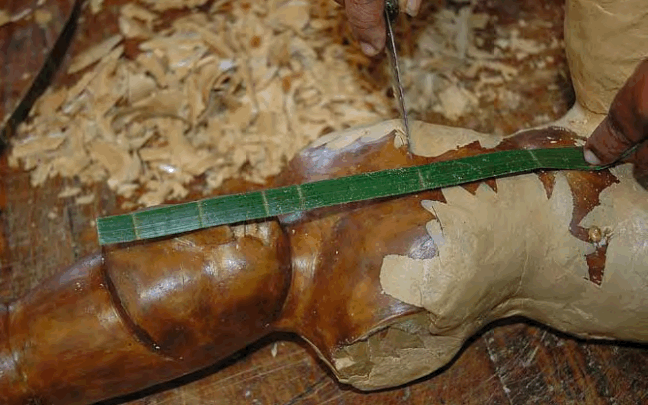 Individual Skilled Craftsmen These are non-hereditary craftsmen who may be talented wax modelers, engravers or both. They may be attached to a Hereditary Family Manufactory or Workshop, an Entrepreneur Owned Manufactory or Workshop or be unaffiliated working out of their own home doing ‘piece work’ for a workshop of some kind. As ‘out workers’ who produce wax models in their homes, they save the non-hereditary workshop money as the latter individuals are able to elude taxation.
Finally, the number of individuals working in any one of these types of workshops outlined above is fluid and ultimately depends of the skills of the workshop owners in securing commissions for work. If large orders from temples or other institutions are secured, the workshop (of whatever scale) may draw on the floating pool of skilled craftsmen in the village and employ them on a temporary or sub-contract basis.